


Next: 3.3 Adjoint Up: 3 SE(3): Rigid transformations Previous: 3.1 Representation
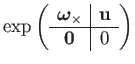
The exponential map from
 to
to
 is
the matrix exponential on a linear combination of the generators:
is
the matrix exponential on a linear combination of the generators:
 |
 |
 |
(61) |
 |
 |
 |
(62) |
|
 |
(63) |
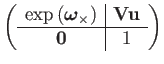
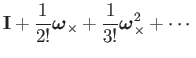
The rotation block is the same as for
 , but the translation
component is a different power series:
, but the translation
component is a different power series:
|
|
 |
(64) |
 |
|
 |
(65) |
Again using the identity from Eq. 9, we split the terms by odd and even powers, and factor out :
|
|
![$\displaystyle \mathbf{I}+\sum_{i=0}^{\infty}\left[\dfrac{\boldsymbol{\omega}_{\...
...s}^{2i+1}}{(2i+2)!}+\dfrac{\boldsymbol{\omega}_{\times}^{2i+2}}{(2i+3)!}\right]$](img140.png) |
(66) |
|
 |
(67) |
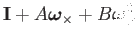
The coefficients can be identified with Taylor expansions, yielding
a formula for
 :
:
|
|
 |
(68) |
|
 |
(69) |
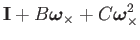
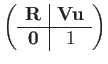
Thus the exponential map has a closed-form representation:
 |
|
 |
(70) |
 |
|
 |
(71) |
 |
|
 |
(72) |
 |
|
 |
(73) |
 |
|
 |
(74) |
 |
|
 |
(75) |
|
|
 |
(76) |
 |
|
 |
(77) |
For implementation purposes, Taylor expansions of  ,
,  , and
, and
 should be used when
 is small.
The  function on
can be implemented by first
finding
function on
can be implemented by first
finding
 as shown in Eq. 18, then constructing
, and finally solving
as shown in Eq. 18, then constructing
, and finally solving
 for
for
 (e.g. using Gaussian elimination with partial pivoting).
Ethan Eade 2012-02-16